



The complex fluid and instabilities group is one of the five groups of the Institut Jean Le Rond d'Alembert, which came into existence on January 1, 2007. The Institute is a laboratory of Science and Ingeneering Faculty of Sorbonne University on campus Pierre et Marie Curie. It is sponsored by the National Center for Scientific Research (CNRS) .
Fluides Complexes et Instabilités Hydrodynamiques
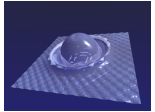 Fluid mechanics opens on problems of ever increasing complexity. Complexity may arise because the Navier-Stokes equation, although deceiptively simple engenders ever more complex solutions such as contorted vortical flows. Hydrodynamic instabilities occur in a bewildering variety of symmetries and mechanisms.
When capillarity and interfaces are added the whole complex phenomenology of droplets and bubbles is obtained. Large numbers of droplet and bubbles, or solid particles, create an additional layer of complexity as in atomizing jets and sprays or sedimenting flows. Eventually, living systems offer breathtaking complexity.
So, flows in the Nature and Environmental fluid mechanics are at the hearth of the interests of the group.
Most of the research in the group is "curiosity driven". Nevertheless, innumerable areas of target-oriented research are based on the Fluid Mechanics of Complex Flows. A common theme in the group is to treat the resulting complexity as a bona fide scientific inquiry, in line with the currently hot topics in the international community of theoretical physics, fluid mechanics and applied mathematics.
∂'Alembert Institute
Laboratoire de Modélisation en Mécanique
Most of the members of the group originate from Laboratoire de Modélisation en Mécanique which went out of existence on December 31, 2006.
Location
The group is located in Tower 55-65, 3rd 4th and 5th floor, and 44-54 5th on Campus Jussieu